

on Thu Apr 16 2026
| 6 min. read

Disclaimer: This blog post is meant for informational purposes only and does not constitute professional legal advice. Consult with a local licensed attorney for specific legal guidance.
As a property owner, you’re liable for the people who call your property home. That’s why you carefully screen each potential tenant and then write up a lease agreement explicitly stating who will be occupying the unit. But what does occupying the unit really mean, and when a guest crosses the territory from temporary visitor to ongoing occupant? How can you recognize the situation and enforce your policy?
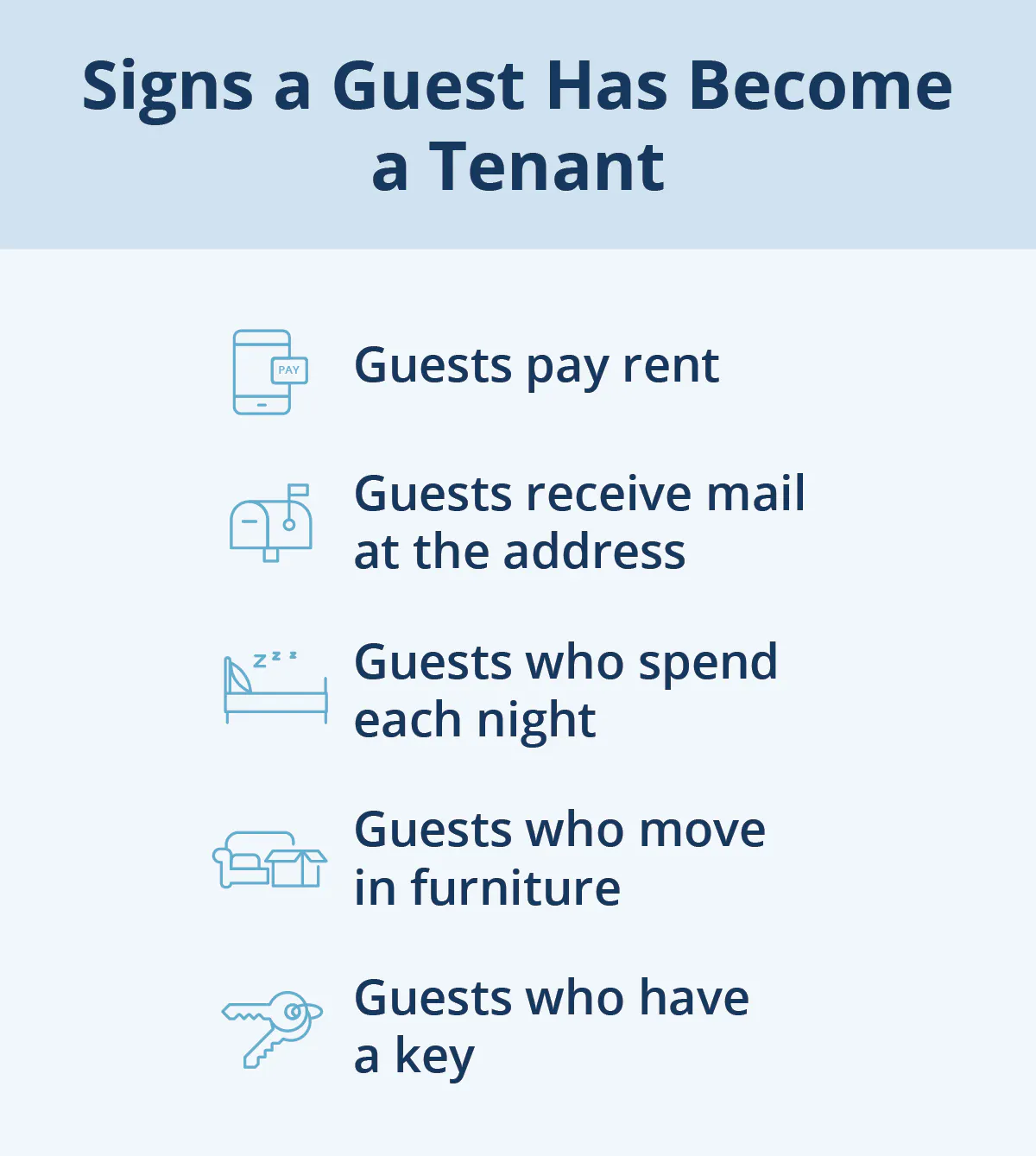
Courts and landlords typically consider several factors when determining if someone has crossed from guest to tenant status. The length of stay is often the most visible indicator, but it's not the only one. Payment of rent or utilities, possession of keys, receiving mail at the address, storing belongings permanently, and listing the property as their primary residence on official documents all signal that someone has moved beyond a casual visit.
The challenge for landlords is that these factors don't always appear together, and there's rarely a single moment when the shift happens. Someone might stay for weeks without paying rent, while another person might contribute to household expenses after just a few days. Understanding these nuances helps you recognize potential issues before they escalate into legal disputes that complicate managing rental tenants.
The gray area is home to those long-term guests who have moved into your rental without your permission. Some ways to spot these guests-gone-rogue include the following:
g
If you’ve noticed these behaviors above in a vacant unit, you could have a squatter on your hands. It’s important you take action to address both long-term guests and potential squatters immediately to prevent more serious legal issues down the road. Preventative action is even better.
If you’ve noticed these behaviors in an occupied unit, you likely have a long-term guest who’s turned into a tenant. To help you distinguish the difference further, here are examples of different situations, where individuals can be considered a guest, and where they can be considered a tenant.
State laws vary widely on when a guest becomes a tenant, which is why checking your local regulations is essential. Some states set specific timeframes that trigger tenant status, while others leave the determination to case-by-case analysis based on the factors mentioned above.
As of March 2024, these are the laws regarding a guest becoming a tenant in each state. However, for the most accurate and up-to-date requirements, reach out to a local legal expert.
The following states have official cut-off points for determining when a guest becomes a tenant:
Alabama: 30 days
Arizona: 29 days
California: 14 days within 6 months, or 7 nights in a row
Colorado: 14 days within 6 months
Connecticut: 14 days within 6 months
Florida: 14 days within 6 months, or 7 nights in a row
Georgia: If the guest contributes towards rent or provides services to live at the property
Illinois: If the guest establishes residency (by receiving mail to the property address, puts the property address on official identification documents, etc.)
Indiana: 30 days
Kansas: 30 days
Maine: 14 days within 6 months
Maryland: If the guest contributes towards rent or provides services to live at the property
Minnesota: If the guest contributes towards rent or provides services to live at the property
Mississippi: If the guest contributes towards rent
Missouri: 14 days within 12 months
New York: 30 days
North Carolina: 14 days
Oregon: 14 days within 6 months
Ohio: 30 days
Pennsylvania: If the guest contributes towards rent or after 30 days
Texas: If not defined in the rental agreement, then if the guest contributes towards rent or establishes residency (by receiving mail to the property address, puts the property address on official identification documents, etc.)
The following states do not have official cut-off points for determining when a guest becomes a tenant:
In states without an official cut-off point, courts will look at a variety of factors to determine whether a guest has become a tenant, including:
Given the complexity and variability of these legal matters, it's advisable to consult with local legal authorities or an attorney experienced in property law. Operating without a clear guest policy is like driving without insurance: everything seems fine until something goes wrong. The risks of not having a written policy extend far beyond simple lease violations.
A written guest policy prevents these problems by setting clear expectations from day one. It protects both you and your tenant by eliminating ambiguity about who can stay, for how long, and under what conditions. This clarity helps attract responsible tenants who appreciate professional management and reduces conflicts that can damage your landlord-tenant relationship. For more on building strong tenant relationships, see our guide on finding and keeping great tenants.
When writing the tenant guest policy in your lease, you should consider the following points regarding visitors:
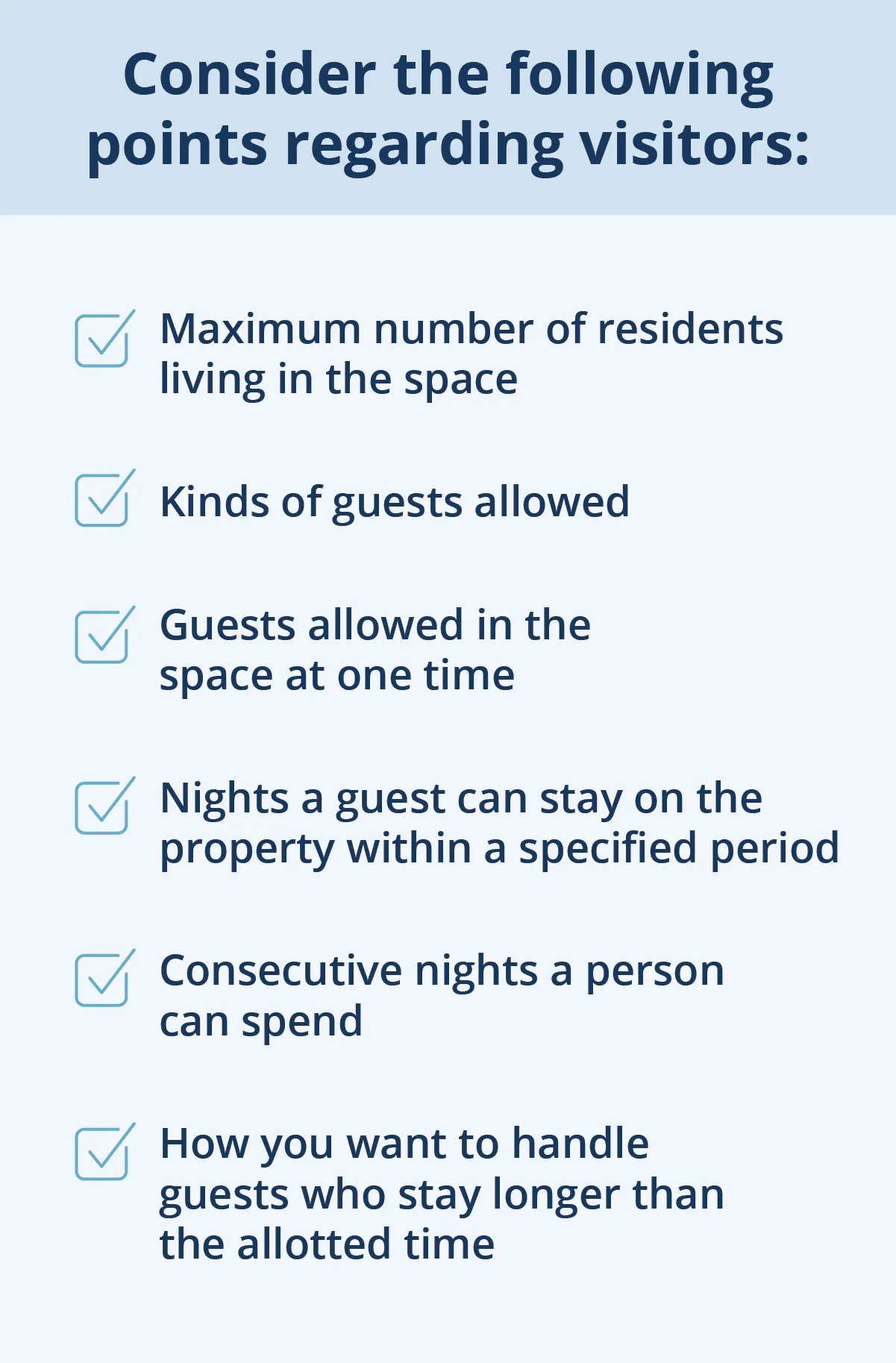
As the property owner, you also get to decide the maximum occupancy of the unit. How many people do you feel comfortable living in the space? If there are five bedrooms, but you’d prefer to have only four occupants in the space, for example, that’s acceptable as long as it’s stipulated in the rental agreement guest policy.
If there are two bedrooms, but you’re fine with having tenants share a room, you can state the maximum number of occupants as three.
You also get to define at what point a guest overstays their welcome. Most landlords allow guests to stay over no more than 10-14 days in a six-month period. From there, you can decide whether a guest staying 15 days or longer gives you grounds to evict the tenants for breaking the lease or whether you want to amend your lease and if the rent will increase as a result.
For example, you can adjust the language below in your own rental agreement guest policy to fit your needs:
Guests may stay a maximum of 14 days on the property in a six-month period or 7 nights consecutively. Any guest residing at the property for more than 14 days in a six-month period or spending more than 7 nights consecutively will be considered a tenant. This person must be added to the lease agreement. The landlord may increase the rent whenever a new tenant is added to the lease.
However, we recommend customizing your tenant guest policy to protect your property rather than falling into the trap of using a standard lease agreement. Consult with your attorney as well to prevent any issues before they begin.
When bringing in new tenants, establishing a good landlord-tenant relationship from the start of the lease is important. This way, you can be clear about the rules of your property and explain the consequences of breaking them, as well as keep channels open for communication.
If you find that a guest has violated a part of your lease agreement, it’s necessary to confront the tenant and take action as soon as possible. You can offer the option to amend the lease, as outlined in your tenant guest policy, or to renew the lease at a higher rate and for a longer term.
When it comes to increasing rent, be aware of your local jurisdiction’s laws surrounding the matter. If you’ve successfully created a positive landlord-tenant relationship, you should be able to talk out any changes or violations to the tenant guest policy freely.
As a landlord, it’s important to have all adult occupants on the lease. This is so you can guarantee their obligation to uphold the lease terms and verify who is living on your property. It also protects you legally if they were to violate a portion of the lease.
If you choose not to amend the lease, you can order the guest to vacate or stay over less frequently in accordance with the tenant guest policy. Otherwise, your option is to serve the tenant with a violation notice and threaten to terminate the agreement with eviction. If you choose this route, you must also provide written notice to the renter(s) of their eviction with the lead time governed by the state and bring in an attorney.
Creating and enforcing a guest policy requires legal knowledge, consistent monitoring, and professional communication skills. For many landlords, especially those managing multiple properties or living far from their rentals, handling these tasks personally becomes overwhelming.
Professional property managers bring expertise in drafting legally compliant policies tailored to local laws. They know the specific requirements in your jurisdiction and can create policies that protect your property while avoiding common legal pitfalls. They also handle enforcement consistently, using established procedures that treat all tenants fairly and document everything properly.
When guest violations occur, property managers communicate with tenants professionally and escalate issues through proper legal channels when necessary. This removes the emotional component that can complicate landlord-tenant relationships and ensures that enforcement follows the law.
Perhaps most importantly, property managers provide peace of mind. Instead of worrying about whether that unfamiliar car means you have an unauthorized occupant, you can rely on professionals who monitor these issues as part of comprehensive tenant management. They handle the details so you can focus on growing your portfolio or simply enjoy a more hands-off investment.
If you're interested in finding a property management company near you, try ourfree property manager search tool today!